Posts

Showing posts with the label Vikings

Sources on Iceland 3: The Sagas

Image
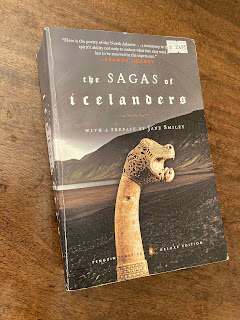
  If you want to understand Iceland you need to read the sagas. But which ones – there are loads of them? These are the ones I enjoyed the most. It is well worth paying for a good translation - here the Penguin Classics brand earns its reputation for reliability. Penguin publishes a 700-page compendium of about thirty of them, entitled The Sagas of the Icelanders . Njal’s Saga. The longest and best. A legal thriller. The hero is Njál, a canny lawyer who tries and fails to mediate between families bearing grudges. Egil’s Saga. Egil was a great warrior with a bad temper and a flair for poetry. The Laxdaela Saga. A love triangle between three inhabitants of Breidafjördur: Gudrun, Kjartan and Bolli. Much blood is shed. Gudrun is one of the most fascinating characters in the sagas: don't mess with her. Grettir’s Saga. Grettir is an outlaw with a bad temper who fights humans and the undead. Eyrbyggja Saga or The Saga of the People of Eyri. The quarrels of various families in Snaefellsnes...

Vinland: Gudrid and her husband discover America

Image
  In my last blog post, I described how Gudrid the Wanderer wandered from Iceland to Greenland. But she didn't stop there. The two Vinland Sagas disagree on who first made landfall in North America, which became known as 'Vinland'. One saga says it was Bjarni Herjólfsson, who got lost on the way to Greenland, the other says it was Leif Eriksson, Erik the Red's son. These days Leif seems to get all the credit. Anyway, Leif, Thorfinn Karlsefni and Thorfinn's new wife Gudrid made a series of expeditions to Vinland, or Vínland in Old Norse, so called because of the discovery of grapes there.  By the way, the photograph above is of Eiriksfjord in Greenland from where Leif Eriksson and his wife Gudrid set sail for Vinland. The iceberg seems to be giving me the finger, I'm not sure why. The sagas describe the establishment in Vinland of temporary settlements at 'Leif's Booths' and 'Keel Point', as well as a tantalizing journey far to the south to ...

Greenland: Gudrid the Wanderer wanders all over the place.

Image
  I first heard of Gudrídur Thorbjarnardóttir, or Gudrid the Wanderer, when I was visiting my ecclesiastical contact, the Reverend Sara . She showed me her church, an amazing modern building with an altar bathed in light reflected off water, in the Reykjavík suburb of Grafarholt. The church was dedicated to Gudrid. She told me about Gudrid's travels from Iceland to Greenland to North America and back again, and then on to Rome, all around the year 1000 AD. I found this extraordinary; I still do. As I discovered more about Gudrid, I determined to write a book about her. But writing a twenty-first-century detective novel about a Viking explorer is not easy. It took me several years to alight on a way of doing it, but I got there in the end.  A TV crew is making a documentary about Gudrid, following in her footsteps to Greenland and North America, when someone is murdered. Magnus investigates. The resulting book is called The Wanderer . Before Magnus could get on the case, I nee...

Favourite Places – The Berserkjagata

Image
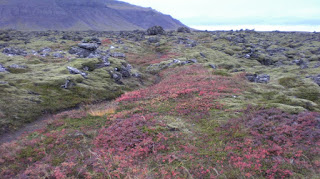
  The Berserkjagata is signposted, but it’s hard to locate. As you descend from the pass, you turn left on the main road from Stykkishólmur to Grundarfjördur, the D54, and after a short distance turn right, following a sign to Bjarnarhöfn. After about a kilometre driving through the Berserkjahraun, the road forks. You take the right fork and park on the road just at the edge of the lava field, where the road comes closest to the shore.  Look out for a tiny wooden signpost to the Berserkjagata, but even now it is hard to find. Walk across the grass to the lava and you will find a narrow path cut into the rock. This is the Berserkjagata, the ‘Berserkers’ Street’, a path from Hraun to Bjarnarhöfn cut through the rocks by the two berserkers a thousand years ago. Follow it. In a few moments, you will find yourself out of sight of the road, alone in a sea of stone. By now you will be familiar with Iceland’s lava fields, but this is a great one to walk through. The lava rears up in...

Snaefellsnes: in search of myth and superstition

Image
  I wrote my story about my demonstrators in the Parliament Square, and their plans to take justice into their own hands. I called it 66 Degrees North , which is the latitude upon which Iceland sits. It’s also the name of an Icelandic clothing company   I checked and they were quite happy to have their brand as the title of the book.  Unfortunately, my US publishers decided that Americans wouldn’t understand the concept of latitude, and so the book is called Far North in America. This is inconvenient for everyone: in an age of social media which transcends boundaries, I live in fear that some of my American readers will buy the same book twice. And, as far as I can tell, Americans do understand the concept of latitude. We need some myth I sent the book to Nic, my editor at Corvus. He liked the story. But he said it should include some of the myth and superstition that infused my first book, Where the Shadows Lie . Very occasionally editors try to make you do things that...

The Hunt for a Lost Saga

Image
I was on the hunt for a plausible lost saga. How did it get lost? Whom was it about? Originally, the sagas were written down by monks on vellum (calfskin). They used quills from the left wings of ravens or swans better for right-handed scribes and ink made from willow or bearberry. There were hundreds, possibly thousands of copies of the sagas scattered throughout Iceland. Árni Magnússon By the eighteenth century, an Icelandic scholar who lived in Denmark named Árni Magnússon became worried that the stories might become lost, and travelled around Iceland for ten years collecting them. Iceland was poor, and he found scraps of vellum containing sagas repurposed for all kinds of everyday uses, such as shoe insoles or the back of a waistcoat.  He gathered his collection together in fifty-five boxes, and took them all back to Copenhagen in 1720. He became the librarian at the Royal Library, and stored the sagas there. In 1728, a fire swept through Copenhagen , destroying the library....

Seeing a man about a saga

Image
  I needed someone to speak to about sagas. I found a lecturer in Icelandic Literature, Thorsteinn.    His office was on the top floor of the old building of the University of Iceland. Rather unsettlingly, this reminded me a little of my trip to Berlin to research my 1930s novel: it had a touch of the Nazi Gothic about it. Thorsteinn’s office was small and academic, with the exception of an unexplained Barbie doll on the top shelf. Nothing in Iceland is ever completely serious. There was a view over Reykjavík City Airport to Thingholt and the Hallgrímskirkja. Just in front of the university is a rather elegant statue of an early Icelandic academic, Saemundur the Wise , and a seal. Like many future Icelanders, Saemundur studied abroad, at the Sorbonne in Paris, specializing in the devil and black magic. In the eleventh century, travel from France to Iceland was tricky, so Saemundur did a deal with the devil, who promised to take the form of a seal and give him a lift home....

Gap years raiding and trading: Iceland's history 874-1264

Image
Before there were people in Iceland, there were trees.  Really.  In the ninth century the whole country was covered with trees, and there wasn’t a soul to cut them down.   Discovery        There are hints that Irish monks may have inhabited Iceland during the early ninth century, and a couple of wayward Vikings sailors stumbled across the island while lost, but the first Viking that we know of who sailed there deliberately was a man called Flóki.  He took three ravens with him to help him find Iceland.  He let them loose.  The first two returned to the ship, but the third flew straight off over the horizon.  Flóki followed it and made landfall.    At first Flóki was dismayed by the cold.  He climbed to the top of a mountain and looking out at drift ice choking the island’s fjords, so he decided to call the country ‘Iceland’.  He returned to Norway disappointed, although one of his mates claimed that in sprin...