Posts

Showing posts with the label Reykjavík

Black Fuel: Guest Post from Quentin Bates
Image
Every now and then I intend to slip in a guest post from someone who knows Iceland or Icelandic crime writing. My first victim is Quentin Bates.  Like me, Quentin is an Englishman who writes crime novels set in Iceland.  He has also translated a number of the top Icelandic crime writers into English, including Lilja Sigurdardóttir, Ragnar Jónasson, Solveig Pálsdóttir and Óskar Gudmundsson.  He knows Iceland much better than I do .  He has worked on an Icelandic trawler, lived in the country and married an Icelander.  I recommend his series featuring Sergeant Gunhildur, the first book of which is Frozen Out .  Here he discusses the vital importance of coffee to the Icelanders.   There’s a black fluid that keeps the Nordic countries functioning. I don’t mean the stuff that’s pumped out of the depths of the North Sea by bearded roustabouts, but that other black liquid that’s the staple cliché of every Nordic crime drama. Wallander more or less set th...
Lilja's Richard Museum

Image
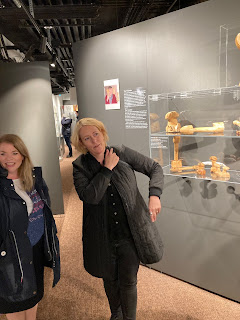
  I am breaking out of my narrative flow with this blog post which describes a visit to a certain museum in Reykjavik. We will call it Lilja's Richard Museum. Why Richard? There is a big problem with this post, and it's the algorithms. The post is about a museum in Reykjavik devoted to a part of the male anatomy. I'm worried that if I use the normal precise anatomical description it will tickle the various algorithms and bots which will read this post in its various guises with unpleasant consequences. Either they will be shocked and try to suppress it (LinkedIn). Or they will get overexcited and promote it to the wrong kind of people and I will be inundated with sleaze (Google/Facebook). Or filters will block this in email form. So I have decided to call the member in question Richard. Could have been William, I suppose. So, let me tell you about Lilja'a Richard Museum . The Richard Museum This is such a typically Icelandic story. I was in Reykjavik recent...

Favourite Places - Mokka Kaffi

Image
Reykjavík has plenty of good cafés, but my favourite is Mokka . It’s a few yards up Skólavördustígur (the Skola Street) on the left, in a building that used to be white but is now raspberry red. It is supposedly the oldest café in Reykjavík, founded in 1958 by an Icelander returning to Reykjavík from Naples where he had been studying music. The warmth and friendliness of the place hits you as soon as you walk in, subtly conveyed by the smell of coffee mixed with waffles and strawberry jam, the house speciality. It’s a small café with leather benches, booths and wood-panelled walls under yellow light. These are hung with pictures by Reykjavík artists that rotate monthly: abstracts, photographs, landscapes, all for sale. Often, the artist will be there too, willing to talk about their work. The staff are young, friendly and of course speak perfect English. I have often suggested Mokka as a place to meet my sources. It has a reputation as a hangout for artists, writers and intellectual...

More Reykjavík: Laugavegur and the 'burbs

Image
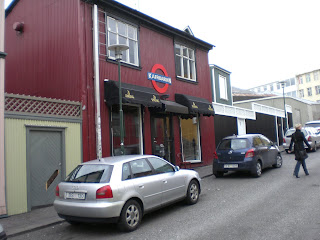
  Laugavegur My Reykjavík researches continued along Laugavegur, which is Reykjavík’s smartest shopping street. Laug means ‘hot spring’, so this was the road from Ingólfur’s original Norse settlement to the geothermal spring, which is now a swimming pool with hot tubs near Borgartún.  It became the route women took to do their washing, and presumably a crowded thoroughfare on Saturday, or laugardagur, when everyone went off for a bath. It’s still a hot place on Saturday night, after my bedtime, since most of the trendy clubs and bars are on this street. The trendiest of these is Kaffibarinn (see above). This is a small metal town house, painted bright red, a few yards up Bergstadastraeti from Laugavegur. It is easily identifiable by the London Underground sign hung above the door. It has an awesome reputation: the place to go on a weekend night for music and violent dancing. It’s supposed to be or have been part-owned by Damon Albarn of Blur, but it’s hard to pin that factoi...

Checking out Reykjavík, walking where my characters walk

Image
  I checked out Reykjavík. I was looking for places people might live, places people might meet, and the odd place someone might get stabbed or shot. It’s a bit morbid, but it’s my job.  I was to revisit all the spots I saw on this first trip many times over the following ten years. In May 2008, the global financial crash was just beginning its downward lurch. It was to hit Iceland particularly hard over the following twelve months. Parliament Square I started where Ingólfur Arnarson started, in Austurvöllur Square, which is a couple of hundred yards south of the bay and in the middle of what is now known as ‘Downtown’.  Austurvöllur is a bit of a mouthful, so let’s call it the Parliament Square, since Parliament is on one side. If you think Reykjavík is small for a capital city now, this is where you realize how seriously small it used to be a hundred years ago.  The square is a patch of green with a statue of a politician in the middle, some scrappy grass and daff...

Favourite Places: Thingholt

Image
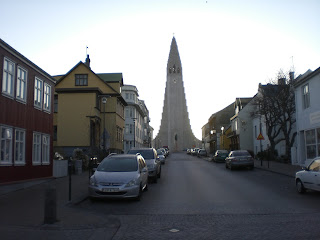
By ‘Thingholt’, I mean the bloody great hill in the middle of Reykjavík with a church on top. I assume that in Viking times, they held one of those ‘thingi’ things here, meaning an assembly. It’s bordered by the Tjörnin pond on the west, Laugavegur to the north, the National Hospital to the east and the City airport to the south. It’s a residential area bang in the middle of town, full of small houses with brightly painted corrugated iron roofs — predominantly red, but also green and blue. The walls are either concrete or corrugated iron, and many are brightly painted too. Most of the houses with corrugated metal walls were built between 1880 and 1925. The rain in Reykjavík frequently falls horizontally, so wooden walls tended to rot. Wood was also expensive, since it all had to be imported, and it burns: much of Reykjavík burned down in 1915. Corrugated iron was all the rage until the Icelanders discovered concrete in the 1920s. The dwellings are small, with little gables and tiny g...

Time to go: researching Reykjavík

Image
In my last post, I described my arduous research trips to places like Rio and South Africa.  But now, for better or worse, I had decided to write several books in a city with appalling weather: Reykjavík. I have looked back at my notes on this trip in May of 2008, and these were my rather disjointed first impressions. First Impressions "It’s small and northern. Despite the cloud, there is a feeling of lightness about the place. Most of Reykjavík is in shades of grey, many of them light grey, brightened by a number of small houses with brightly coloured metal roofs.   It’s a hip, fashion-conscious city, yet innocent at the same time, clean, easy to walk around. Although many streets are narrow, you can usually see some distance to the sea and mountains, so it doesn’t feel cramped. It’s friendly in rather a repressed way.   The air is fresh and cool, with an occasional hint of sulphur. There is not much smell of traffic. The main sounds are the hum, not the roar, of traffi...

Dinner, elves and Björk

Image
Last week, I told you how I visited Iceland on a book tour in 1995.  I had dinner the first evening with my publishers Ólafur, Pétur and three of their colleagues.   On the way, I spotted my first tree!  It was, squat, no more than ten feet high, its naked, twisted branches shivering in the front garden of a small house.  The house itself seemed to be constructed of white-painted corrugated iron with a red-painted iron roof.  Indeed the hill in the centre of Reykjavík seemed to be covered in these brightly painted toy metal houses, gleaming in the evening sunshine.  It was all rather jolly.   We went to a crowded restaurant and ate delicious fish. By this time, I was becoming used to dinners with publishers. Publishers are by and large well-read, friendly, interesting people. The talk often revolves around books, new and old, and people. Despite the bad press they sometimes get, people in book marketing love books as much as editors do. Elves ...