Posts

More Reykjavík: Laugavegur and the 'burbs
Image
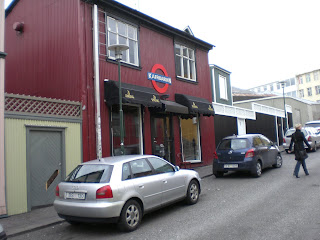
  Laugavegur My Reykjavík researches continued along Laugavegur, which is Reykjavík’s smartest shopping street. Laug means ‘hot spring’, so this was the road from Ingólfur’s original Norse settlement to the geothermal spring, which is now a swimming pool with hot tubs near Borgartún.  It became the route women took to do their washing, and presumably a crowded thoroughfare on Saturday, or laugardagur, when everyone went off for a bath. It’s still a hot place on Saturday night, after my bedtime, since most of the trendy clubs and bars are on this street. The trendiest of these is Kaffibarinn (see above). This is a small metal town house, painted bright red, a few yards up Bergstadastraeti from Laugavegur. It is easily identifiable by the London Underground sign hung above the door. It has an awesome reputation: the place to go on a weekend night for music and violent dancing. It’s supposed to be or have been part-owned by Damon Albarn of Blur, but it’s hard to pin that factoi...
Checking out Reykjavík, walking where my characters walk

Image
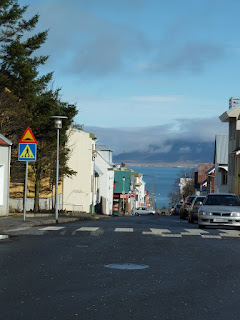
  I checked out Reykjavík. I was looking for places people might live, places people might meet, and the odd place someone might get stabbed or shot. It’s a bit morbid, but it’s my job.  I was to revisit all the spots I saw on this first trip many times over the following ten years. In May 2008, the global financial crash was just beginning its downward lurch. It was to hit Iceland particularly hard over the following twelve months. Parliament Square I started where Ingólfur Arnarson started, in Austurvöllur Square, which is a couple of hundred yards south of the bay and in the middle of what is now known as ‘Downtown’.  Austurvöllur is a bit of a mouthful, so let’s call it the Parliament Square, since Parliament is on one side. If you think Reykjavík is small for a capital city now, this is where you realize how seriously small it used to be a hundred years ago.  The square is a patch of green with a statue of a politician in the middle, some scrappy grass and daff...

Favourite Places: Thingholt

Image
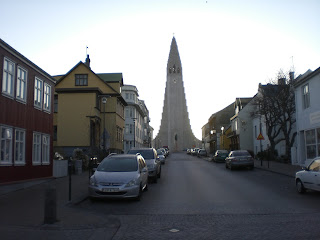
By ‘Thingholt’, I mean the bloody great hill in the middle of Reykjavík with a church on top. I assume that in Viking times, they held one of those ‘thingi’ things here, meaning an assembly. It’s bordered by the Tjörnin pond on the west, Laugavegur to the north, the National Hospital to the east and the City airport to the south. It’s a residential area bang in the middle of town, full of small houses with brightly painted corrugated iron roofs — predominantly red, but also green and blue. The walls are either concrete or corrugated iron, and many are brightly painted too. Most of the houses with corrugated metal walls were built between 1880 and 1925. The rain in Reykjavík frequently falls horizontally, so wooden walls tended to rot. Wood was also expensive, since it all had to be imported, and it burns: much of Reykjavík burned down in 1915. Corrugated iron was all the rage until the Icelanders discovered concrete in the 1920s. The dwellings are small, with little gables and tiny g...

Time to go: researching Reykjavík

Image
In my last post, I described my arduous research trips to places like Rio and South Africa.  But now, for better or worse, I had decided to write several books in a city with appalling weather: Reykjavík. I have looked back at my notes on this trip in May of 2008, and these were my rather disjointed first impressions. First Impressions "It’s small and northern. Despite the cloud, there is a feeling of lightness about the place. Most of Reykjavík is in shades of grey, many of them light grey, brightened by a number of small houses with brightly coloured metal roofs.   It’s a hip, fashion-conscious city, yet innocent at the same time, clean, easy to walk around. Although many streets are narrow, you can usually see some distance to the sea and mountains, so it doesn’t feel cramped. It’s friendly in rather a repressed way.   The air is fresh and cool, with an occasional hint of sulphur. There is not much smell of traffic. The main sounds are the hum, not the roar, of traffi...

How to describe places: my research technique

Image
My first visit to Iceland was going to be very different from the book tour in 1995. This time I had to build up a store of the impressions, the feelings, the sounds, the smell and the little details to fuel my writing of the first draft of my novel over a six-month period. Research Technique I had researched many settings for my previous novels — Fife, Brazil, Massachusetts, Prague, Clerkenwell, the Cote d’Azur, Wyoming, South Africa and 1930s Berlin — so I knew what I was doing, but I was daunted. Before, most of my characters had been flying in and out of places. This time Magnus and my characters were stuck in Iceland for at least three books, maybe more. I had better get it right. Over the years, I have developed and refined a method for gathering information on locations for my books. I wander around with a tape recorder, a camera and a notebook, my eyes and ears on high alert, taking note of anything I see or hear that might be useful. I use the tape recorder most, muttering in...

One degree of separation: Icelandic society

Image
Magnus is an Icelander and an American, which can be confusing for the poor guy.   He has to fit in.  But fit into what? What is Icelandic society like?   Icelandic Women Tucked into that per-capita list in my last post, was ‘gender equality’.  The generalisation goes that women are tough, independent and well-educated in Iceland.  Although they are not paid the same as men, pay is closer than in other countries.  Iceland had the first elected female president, Vigdís Finnbogadóttir who was elected in 1980.    The success of women is ascribed by some to the fact that many were left alone to manage while their husbands went away to sea.  Some say that having children early helps.  Women will often have their first child while still at university, which means that when they are in their early thirties they have older children and are able to struggle with men on equal terms on the career ladder.   On Friday 24 October 1975, Icel...

Not quite Scandinavians: the Icelanders

Image
So, Magnus is an Icelander.  But what are Icelanders really like?   Now that is a dangerous question.  Dangerous because we are in the territory of playing with stereotypes.   The Problem with Stereotypes           I first came across the notion of stereotype at school studying history.  I think I had suggested that the first world war started because Germans liked invading people.  I was admonished, quite rightly, and told that ‘stereotypes’ had no place in history.  You couldn’t say that Italians were excitable, the French didn’t queue, the Americans were loud or that the Germans liked invading people.  It was bad history, it was often plain wrong and it was morally dubious.  All true.             And yet.  It is hard to suggest that the unification of Germany or even the origins of the first world war can be analysed without some u...